Frozen pipes
A frozen pipe hasn't burst yet. How you thaw it largely determines whether it does.
Free to call. We route you to an independent licensed plumber in your area — PlumbLinker does not perform plumbing work.
Find the frozen section
Open the affected faucet first — both hot and cold. This relieves pressure and gives melting ice somewhere to go. Then trace back along the supply line looking for the cold spot.
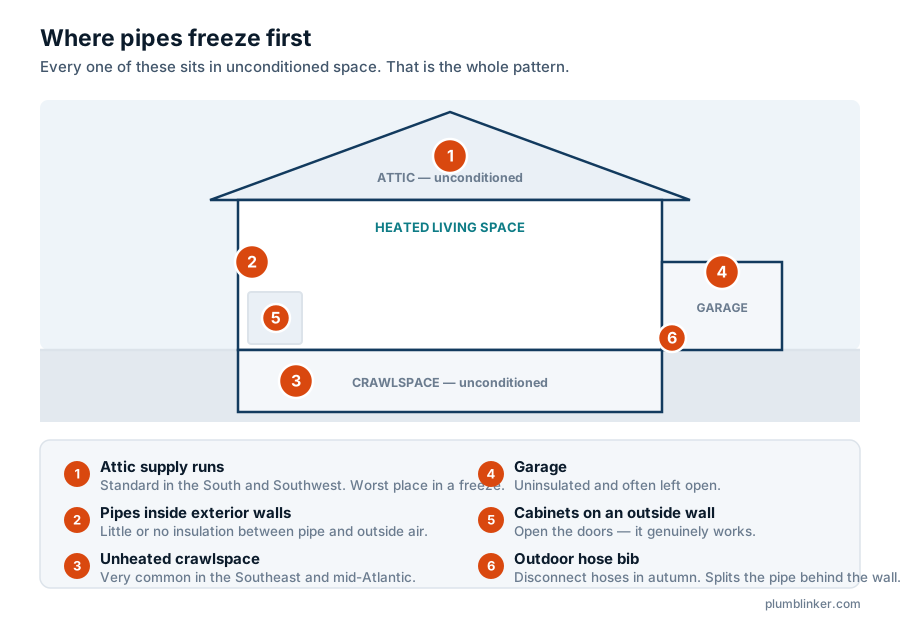
Freezes almost always happen in the same places: exterior walls, unheated crawlspaces, attics, garages, basement rim joists, and under kitchen sinks on outside walls. Look for visible frost or condensation on the pipe, or a section noticeably colder to the touch.
If only one fixture is dry, the freeze is local to that branch. If nothing in the house has water, check the main line where it enters the building — a main line freeze is a considerably bigger problem and worth calling about sooner.
Thawing safely
- Leave the faucet open throughout. Running water — even a trickle — accelerates thawing and relieves pressure.
- Apply gentle heat starting nearest the faucet and work backward toward the frozen section. This gives meltwater an escape route. Heating the middle first traps expanding water between two ice plugs, which is how pipes split.
- Use a hair dryer, a heating pad, warm towels, or a space heater in the area. Slow and steady.
- Open cabinet doors under sinks so warm room air reaches the pipes.
- Keep going after water starts flowing — there may be more ice further along.
No blowtorch, propane torch, or kerosene heater against a pipe. It's a leading cause of house fires during cold snaps, it can heat the pipe wall past the point of failure, and on plastic pipe it's immediately destructive.
If it has already split
You often won't know until it thaws — the ice is plugging its own leak. Watch closely as water returns. If it starts flowing anywhere it shouldn't, shut the main off immediately. See burst pipe repair.
Where pipes freeze first
Preventing the next one
| Measure | Notes |
|---|---|
| Let faucets drip during hard freezes | Moving water resists freezing, and an open faucet relieves the pressure that actually splits pipes. Cheapest insurance there is |
| Open cabinet doors under sinks | Especially on exterior walls. Costs nothing |
| Keep the thermostat at 55°F minimum | Including when away. Never turn heat fully off in winter |
| Insulate pipes in unheated spaces | Foam sleeves are inexpensive and effective |
| Heat tape on vulnerable runs | For pipes that freeze repeatedly. Use a UL-listed product and follow instructions exactly |
| Disconnect garden hoses before winter | A connected hose traps water in the spigot and splits the pipe behind it. Very common and entirely avoidable |
| Seal air leaks near pipes | Rim joists, crawlspace vents, and gaps where lines enter the house |
| Know your main shutoff | The difference between a repair and a renovation |
Homes in the South and Southwest often have pipes run through attics, exterior walls, and uninsulated crawlspaces because deep freezes are rare. When one arrives, damage is widespread and every plumber in the region is booked for days. If you're in one of those areas, dripping faucets during a freeze warning matters more for you than for anyone in Minnesota.
Frequently asked questions
How do I know if my pipes are frozen?
No water or a trickle from a faucet when it's below freezing, visible frost on an exposed pipe, a section noticeably colder than the rest, or bulging. If one fixture is dry and others work, the freeze is in that branch.
How long does it take to thaw a frozen pipe?
With direct gentle heat, typically 30 minutes to a few hours depending on how thoroughly frozen it is and how cold the space is. Don't rush it with higher heat — that's what causes splits.
Will a frozen pipe always burst?
No. Many thaw with no damage. The split happens because expanding ice pushes water toward a closed faucet and pressure builds between the ice plug and that closed valve. Opening the faucet removes that pressure, which is why it's the first thing to do.
Should I leave faucets dripping in cold weather?
Yes, during hard freezes — particularly for fixtures on exterior walls and any pipe run through an unheated space. A slow drip costs pennies and relieves the pressure that splits pipes.
What if the frozen pipe is inside a wall?
Turn the room's heat up and let it work slowly. Direct a space heater at the wall, keeping safe clearance. If nothing has moved after a few hours, call — opening a wall is preferable to a burst inside it.
Plumbing emergency right now?
One call routes you to an available licensed plumber in your area. Free to call, 24 hours a day.
Call (888) 876-3092PlumbLinker is a referral service. We connect you with independent licensed plumbers — we do not perform plumbing work ourselves.